
Recruiting is entering a new era. Artificial Intelligence (AI) isn't just helping — it's being embedded so deeply that whole recruiting workflows are becoming agentic. That means AI agents aren't just answering FAQs or ranking resumes — they're autonomously working through sourcing, screening, verifying, and helping candidates and recruiters interact in rich, fast, human-like ways.
With high competition, surging application volumes, and evolving candidate expectations, companies that don't adopt smarter, more agentic recruiting risk being overwhelmed. Meanwhile, candidates need to find ways to stand out in increasingly crowded pools.
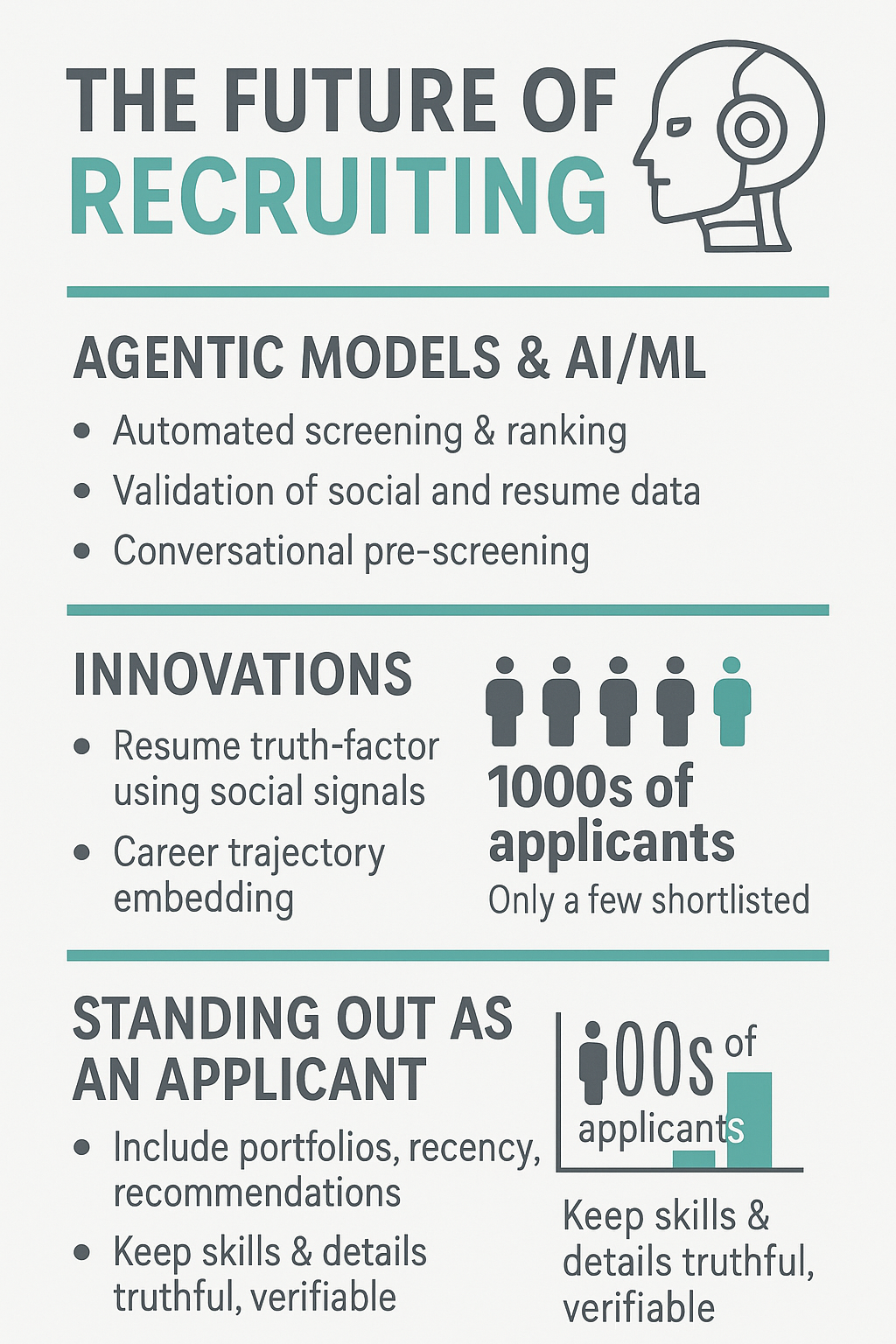
Visual overview of agentic AI recruiting trends, application volume statistics, and future workflow innovations
Rising Application Volumes & Why It's a Big Problem
The Numbers Are Staggering:
Applications for a single developer job posting
Source: Reddit reports
Average applications per UK graduate vacancy (59% increase YoY)
Source: Financial Times 2024
Average candidates per online job posting
Source: SelectSoftware Reviews
Applicant-to-interview ratio on average
Source: CareerPlug
These Numbers Lead to Several Challenges:
Recruiter Overload
Cannot hand review 1000+ resumes for every role and expect to pick the best 5-10 quickly
Lost Talent
Many good candidates are lost in the noise
Candidate Frustration
Delays and automated filters lead to dissatisfaction and drop-off
What Are Agentic Models in Recruiting?
An agentic model means multiple AI agents working together, each handling specialized tasks, sometimes autonomously or semi-autonomously, to optimize the recruiting flow.
McKinsey Research
Describes agentic AI in recruitment as using clean data agents, screening/ranking agents, scheduling agents, agents that do outreach or engagement, and coordinating agents that manage the pipeline.
Eightfold AI
Writes about agentic AI augmenting recruiting by "quickly surfacing top talent and reducing time to hire."
Deloitte Trends
Lists agentic AI among the key Talent Acquisition technology trends for 2025.
How Agentic & Advanced AI/ML Models Will Shape Recruiting
Here's what the future (and present very soon) looks like, driven by agentic AI & advanced ML:
🎯 Automated Screening & Ranking with Contextual Intelligence
Rather than just keyword matching, AI agents will use large language models + embeddings + career graphs to understand candidate trajectories, skill recency, technology usage.
Example: If your last experience with a technology was 10 years ago vs 1 year ago, that weight matters. Agents can infer seniority, complexity, domain overlap (e.g. financial vs healthcare tech).
🔍 Multi-Modal Data, Social & Validation Signals
Resumes are static. But a candidate's LinkedIn profile, GitHub, portfolios, contributions, even recommendations become important.
Data Sources
- • LinkedIn profiles & endorsements
- • GitHub contributions & repos
- • Portfolio projects & outcomes
- • Professional recommendations
Validation Layer
- • Credential verification
- • Degree authenticity
- • Employer matches
- • "Truth factor" scoring
💬 Conversational Pre-Screening & Forms Embedded in the Flow
Chat agents that ask follow-up questions, clarify experience, collect missing data via forms -- before any human recruiter looks. This lowers friction, ensures recruiters only see candidates who meet minimal criteria.
📅 Self-Scheduling & Interview Coordination Agents
Agents that sync across many calendars, propose slots, reschedule, manage time zones, and send reminders. All to reduce the "back and forth" time killers.
🤝 Agentic Engagement Agents
To keep candidates warm: reminders, messages, status updates, feedback. To handle FAQs. To reduce candidate dropout and negative candidate experience.
⚖️ Fairness, Bias Mitigation & Transparency Agents
Because when scaled, AI can pick up or amplify biases. Agents will monitor for bias (gender, race, school bias etc.), enforce fairness rules, and provide explanations. Transparency will become a competitive differentiator.
📊 Predictive Analytics & Workforce Planning
Agents that forecast hiring needs, suggest candidate pipelines, anticipate skills gaps. Recruiters will shift from reactive hiring to strategic resource planning.
Innovations & "Truth Factor"
To deal with massive application load, and to pick better candidates, some innovations that are emerging or ripe for patentable ideas:
Resume Social Cross-Verification Layer
Automatically pull in social media signals (LinkedIn, GitHub, StackOverflow) to validate skills claimed on resumes.
Example: If a candidate says "ReactJS," also see recent repos or contributions, or endorsements.
Candidate Activity & Recency Graphs
How recent was the work? Not just date but proportion of work time. Agents compute a "recency score" per skill.
Career Trajectory Embeddings
Represent a candidate's career path as a vector or graph, capturing promotions, role changes, domain shifts. Compare that to average paths for given jobs.
Agentic Resume Validation Agent
Automatically identify resume inconsistencies (gaps, overlapping dates, unverifiable claims), verify employer names, degrees etc.
Truth-Factor Scoring Composite
A meta-score that aggregates resume content, social validation, recency, trajectory match, and verified credentials. That can be shown to both recruiters & candidates.
Agentic Feedback Loop
AI agents learn over time which resumes convert to good hires. They adjust weights (e.g. some universities/schools, some experience types) based on real outcome data.
Why Candidates Must Adapt
Given these trends, candidates who want to stand out should:
Make resumes data-rich and truthful
Include public links, portfolios, GitHub, project outcomes
Keep skills fresh
Recent projects, continuous learning
Use social profiles to support claims
Request recommendations
Tailor but don't over-optimize
For "ATS / generative AI" tricks only. Show deeper context
Engage early
Answer screening questions, provide missing info, respond to opportune touches
The Big Scary Numbers & What Recruiters Can Do
It's one thing to say "1000 applications" — it's another to plan for it. Let's look at challenges:
- If a tech company posts a high-profile job, 1,000s of applications can come in in hours (especially with "easy apply" features)
- Applicants sending generic resumes dilute signal, causing both waste (for candidate & recruiter)
- Recruiters simply cannot interview anywhere near that number. With applicant-to-interview ratios of ~3%, even 1,000 apps means ~30 interviews maximum; often less
To manage this:
Smart Filtering
Use agentic validation & screening to filter out low fit early
Bias-Aware ML
Route similar resumes to "diversity or fairness" agents for checking
Transparent Process
Provide quick feedback & transparent process to reduce candidate frustration
Research & Statistics Supporting Agentic Recruiting
Applicant-to-Hire Ratio
According to CareerPlug, the applicant-to-hire ratio in 2024 is ~180 applicants per hire on average.
Source: CareerPlug
Application Drop-off
More than 90% of job seekers never complete applications — often due to cumbersome application processes.
Source: SelectSoftware Reviews
AI Agent Adoption Growth
Salesforce's research states that AI agent adoption is expected to jump ~327% over the next two years, driving up to ~30% gains in productivity.
Source: Salesforce
Agentic AI Trend
Deloitte and other industry watchers list agentic AI at the forefront of talent acquisition trends for 2025.
Source: Deloitte
Putting It All Together: What the Future Recruiting Flow Looks Like
Here's a vision of a future candidate → hire flow, powered by agentic AI:
Application Submission
Candidate applies via smart link or platform; their resume immediately ingested
Validation Layer
Agentic Resume Validator cross-checks credentials, social proof, recency
AI Scoring
Screening & Ranking Agent scores the candidate vs job description, trajectory models, technology graphs
Conversational Engagement
Conversational Chat Agent engages: asks clarifying questions, fills missing forms
Smart Scheduling
Scheduling Agent proposes interview times; if multiple panelists, finds common availability automatically
Continuous Engagement
Engagement Agent sends reminders, feedback. Keeps candidate warm even if delayed
Fairness & Transparency
Transparency & Bias Checking Agent monitors fairness, explains why some candidates passed or were screened out
Challenges & Ethical Considerations
⚠️ Key Challenges
Bias & Fairness
Agentic systems must be designed to avoid perpetuating existing biases
Privacy
Using social data, verification, etc., means handling sensitive information carefully
🎯 Solutions & Best Practices
Transparency
Candidates should know what is being used to score them
Human-in-the-Loop
Too much automation might feel impersonal and reduce candidate experience
Conclusion
The future of recruiting is unequivocally moving toward agentic, AI/ML-driven systems. With application volumes exploding, recruiters can no longer afford to manually process everything. Agentic models, validation layers, smart screening, and incorporating social data will be essential to filter, identify, and interview the best candidates efficiently and fairly.
Candidates must likewise adapt: be authentic, demonstrate recent, verifiable skills, use portfolios and social proof, not just polished resumes. The old model of "send many, hope one sticks" becomes less viable.
SyncUno and platforms like it are positioned to lead this shift:
- Automated resume validation
- Trajectory and social validation
- Engaging chat flows
- Scheduling agents
- Fairness oversight
For the organizations that adopt this early, recruiting becomes faster, better, fairer — and for candidates who understand the signals, more transparent and rewarding.